New - 4 Hours Ago


$240,000
Active
2
Beds
2
Baths
1267
Sqft
0.08
Acres
11436 Squire Way Ln, Jacksonville, FL 32223
MLS#: 2170779



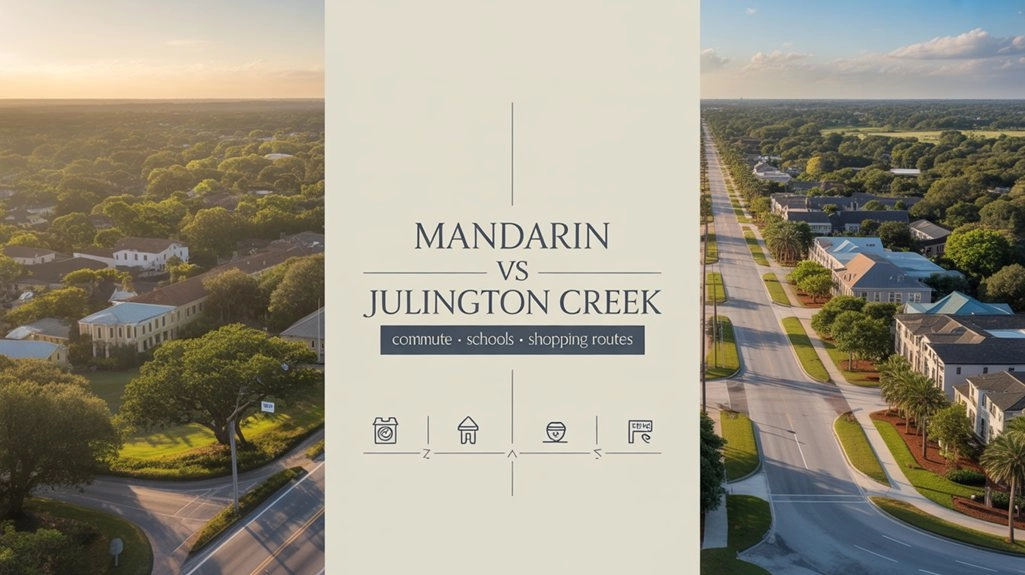
If you’re down to Mandarin and Julington Creek, you’re already past the “where is it?” stage. What you need now is decision clarity for your real estate search: which drive fits your routine, how school assignment works by address, where you’ll run weekly errands, and what to verify before you buy so there are no surprises after you go under contract. By the end, you should be able to say, “For my weekday drive and my priorities, this side fits better.” If you’re also comparing listings, scroll down afterward and you’ll view homes with better context.
Quick note up front: both Mandarin and Julington Creek can feel very different depending on which pocket you’re in. This comparison stays focused on the roads, school tools, and weekly routes that change the day-to-day.
Scope: commute patterns by destination, school assignment and what to verify, weekly errand routes, and housing feel (light + factual). No rankings. No price talk. No neighborhood directory.
Quick jump: Quick decision guide | Commute reality by destination | Schools and verify-by-address | Errands and shopping routes | Housing feel | What to verify before you buy | Cross-shop notes (Fruit Cove) | Bottom line
If you commute toward Downtown or the I-95 spine
Mandarin often makes more sense when your routine pulls you toward Downtown, Riverside/Avondale appointments, or anything that relies on I-95 access. The deciding factor is how quickly your specific Mandarin pocket reaches San Jose Blvd and/or I-295.
If your workday is Southside (Baymeadows, Butler Blvd, Gate Parkway)
Mandarin can feel simpler here because many pockets offer more than one workable connector depending on the address. Julington Creek can still work, but you’re usually starting your drive with Racetrack Rd or SR-13 before you reach the broader Jacksonville connector network.
If you commute Westside / NAS Jax / Orange Park
This pattern is sensitive to how often you’ll use I-295 and the Buckman Bridge segment. Mandarin often feels like the cleaner base for NAS Jax and Orange Park runs. If Julington Creek is still in play for this commute, test the I-295 bridge segment at real departure times before deciding.
If your routine is St. Johns-focused (CR-210, St. Augustine plans, Nocatee-adjacent routes)
Julington Creek usually makes more sense if your weekly routes already sit in St. Johns County. Your repeat roads are typically Racetrack Rd, SR-13, CR-210, and I-295 (East Beltway) depending on destination and which pocket you buy in.
Two quick tests (do these before you commit to a location):
When you compare these two, compare the first few miles from the driveway. If your address feeds quickly to I-295 or a main corridor, the rest of the drive tends to feel more manageable. If your address forces you through one congested connector first, you’ll notice it most weekdays.
Mandarin (in Jacksonville/Duval County) is large, and it doesn’t drive like a single neighborhood. In practical terms, many routines touch San Jose Blvd. If your pocket sits closer to I-295 and San Jose, it’s easier to pivot across Jacksonville for work, school events, and appointments without needing a long setup drive.
Depending on the pocket, Old St Augustine Rd can also become a normal alternate route when you’re trying to avoid a specific slowdown. The key point for homebuyers is pocket-dependent access: some Mandarin addresses give you more than one workable way to aim toward major connectors, and that reduces “one road decides your whole weekday” situations.
Julington Creek is commonly used as shorthand for the Julington Creek area in St. Johns County, including Julington Creek Plantation and nearby Fruit Cove pockets. Many daily routines rely on the same repeat connectors: Racetrack Rd and SR-13. That can simplify life because schools, services, and errands often sit along those routes.
For many households, the drive is two-stage: first, getting through Racetrack/SR-13 patterns from the neighborhood; second, connecting to I-295 (East Beltway) when the destination is more regional (Southside, Westside, or cross-town routes).
This is where a lot of real estate searches narrow fast. Mandarin is in Duval County Public Schools. Julington Creek is in St. Johns County School District. Rather than relying on opinions, keep it practical: school assignment is address-specific, and you should verify it like any other due diligence item.
Mandarin school verification (Duval)
Use the official Duval school finder tool for the exact address you’re considering.
Julington Creek school verification (St. Johns)
Use St. Johns attendance zoning tools to confirm assigned schools by address.
Verify-by-address checklist:
Being close to a school does not guarantee you’re zoned for it. Attendance boundaries and capacity decisions can change how assignment works. If schools are your priority, the address tool step is not optional.
Think of errands in two buckets: the weekly run (groceries, pharmacy, quick dinner) and the bigger run (multiple stops, returns, appointments). The right area is the one that makes the weekly run feel simple from the address you’re considering.
In Mandarin, a lot of the weekly run stays centered on San Jose Blvd. If you’re closer to I-295 and San Jose, you usually have a few nearby centers that become your default for groceries, services, and quick weekday stops.
For bigger errands and wider retail options, many households end up near The Avenues when they want to consolidate several stops into one trip.
If you want a local-feeling reset that still fits normal life, Walter Jones Historical Park is one of those calm places that people actually use, not just a “nice-to-know” name on a list.
In Julington Creek and nearby Fruit Cove pockets, the weekly run often compresses into a smaller set of repeat roads. Racetrack Rd and SR-13 show up again and again, and you’ll quickly learn which direction feels easier from your specific pocket.
For many Julington Creek and Fruit Cove households, Durbin Pavilion is the bigger-errands cluster: the place you go when you want one consolidated trip instead of several separate stops.
You don’t need a dramatic debate here. You just need the differences you’ll notice when you’re driving streets, checking lots, and paying attention to neighborhood upkeep.
Mandarin tends to offer more variety in neighborhood layouts and home styles, and it can change noticeably from one subdivision to the next. Some streets feel older and settled. Some pockets feel newer and more uniform. HOA presence varies by community, so if “fewer rules” is part of your goal, that’s something to verify on the specific property and subdivision documents.
Julington Creek and nearby Fruit Cove pockets often feel more structured. In many communities, rules and recurring obligations are part of the package, and that can be a positive if you want predictable upkeep and shared amenities. It can also be a negative if you want fewer restrictions. The key is to verify the governing documents early and understand what applies to the specific property you’re considering.
Simple clarity question: Do you want built-in community structure, or do you want fewer ongoing rules?
Neither answer is better. The better answer is the one you’ll still feel good about a year from now.
This is the part that protects your decision. Keep it verifiable and address-specific.
A lot of people say “Julington Creek” when they mean a wider slice of Fruit Cove. That matters because the commute and errands pattern changes depending on whether you’re closer to Racetrack Rd, closer to SR-13, or closer to CR-210 access. For a clean comparison, compare Mandarin to the specific Julington Creek/Fruit Cove pocket you would actually buy in, not a general label.
Two common cross-shopping patterns:
If your week is mostly Downtown/I-95 access or Jacksonville-wide job and service runs, Mandarin often feels like the simpler base—especially when you pick a pocket with clean access to San Jose Blvd and I-295. If your life is St. Johns-focused, schools are a primary driver, and your weekly routes naturally sit on Racetrack Rd, SR-13, CR-210, and I-295 (East Beltway), Julington Creek often fits better.
The most reliable way to finalize this decision is to choose two or three addresses you’d genuinely buy, verify school assignment by address, and test the commute at real times. Once you do that, one of these areas usually becomes the clearer fit for your routine.


Mandarin is generally closer and offers more direct access via San Jose Blvd or I-295 without crossing the Buckman Bridge (unless you are coming from the far west side). Julington Creek adds the Racetrack/SR-13 leg plus the I-295 commute, which can add significant time during peak hours.
It depends on your specific needs. Julington Creek (St. Johns County) is often sought after for its highly-rated district-wide consistency. Mandarin (Duval County) has specific schools with excellent reputations and magnet programs, but performance varies more by zone.
Always verify by address using the official district locators, as boundaries change.
Often, yes. While property tax rates are comparable, Julington Creek Plantation (and some Fruit Cove areas) includes CDD (Community Development District) fees on top of regular taxes. These fees pay for amenities and infrastructure.
Mandarin generally does not have CDD fees, though some newer pockets might have higher HOAs.
It varies by pocket. Mandarin has significant riverfront and creek-adjacent areas (Zone AE) where insurance is mandatory for mortgages. However, many inland pockets are in Zone X (lower risk).
Check the FEMA map for the specific address; never assume the whole neighborhood is the same.
The Buckman Bridge connects Mandarin (I-295) to Orange Park/Westside. If your commute requires crossing it (e.g., living in Julington/Mandarin and working at NAS Jax), accidents can cause major delays. Living in Mandarin often gives you better access to the bridge, whereas living in Julington Creek adds the "getting to the highway" step first.
An Orange Park home might make sense for someone reporting to Naval Air Station Jacksonville (NAS Jacksonville). Change the destination to Naval Station Mayport, and that same address raises an entirely different set of driving questions.Both jobs are in the Jacksonville area. But they're on different sides of the region's waterways, and the roads connecting them to a home can make all the differ
A CDD fee helps pay for a community's infrastructure and ongoing upkeep. In Northeast Florida, it commonly appears on the property's annual tax bill, separate from HOA dues. Paying off a home's CDD debt does not eliminate its ongoing maintenance assessment.The useful question isn't just, “Does this home have a CDD?” It's, “What will I owe for this address, what does that money cover, and is it al
_0003.jpg)
If you’re shopping in Northeast Florida, “flood zone” comes up fast — usually right after you fall in love with a porch, a backyard, or a commute that finally feels doable. The tricky part is that water risk here isn’t one single thing. In some areas it’s rivers and creeks. In others it’s drainage and street ponding after summer storms. Near the coast, tide timing can change how quickly stormwate
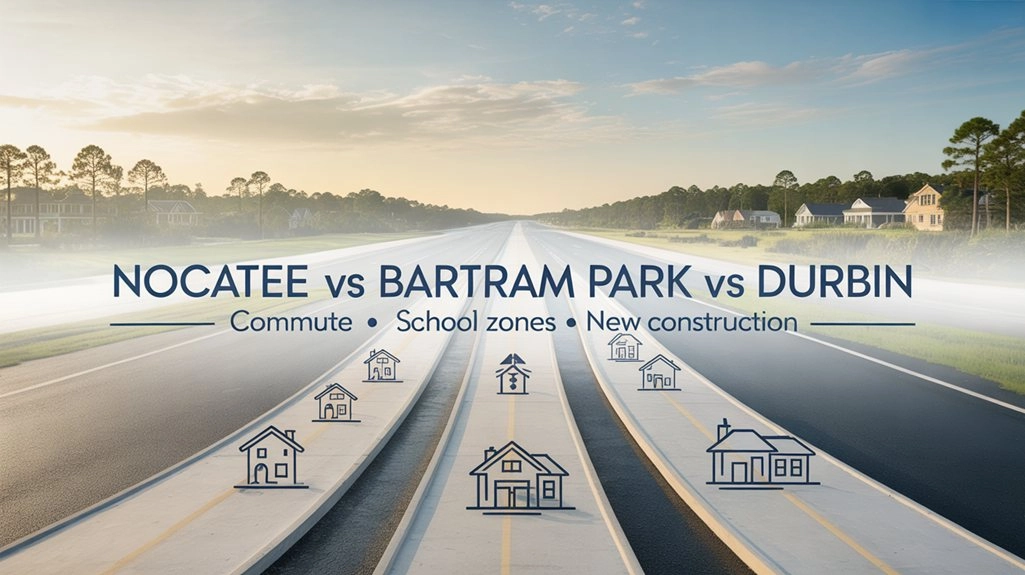
If you’re cross-shopping Nocatee, Bartram Park, and Durbin, you’re usually not trying to crown a winner. You’re trying to figure out which one fits your weekdays without turning every morning into a strategy session. This is a decision article built around three things that actually change the outcome in real estate: commute routes that behave differently at peak hour, school assignment by addre