




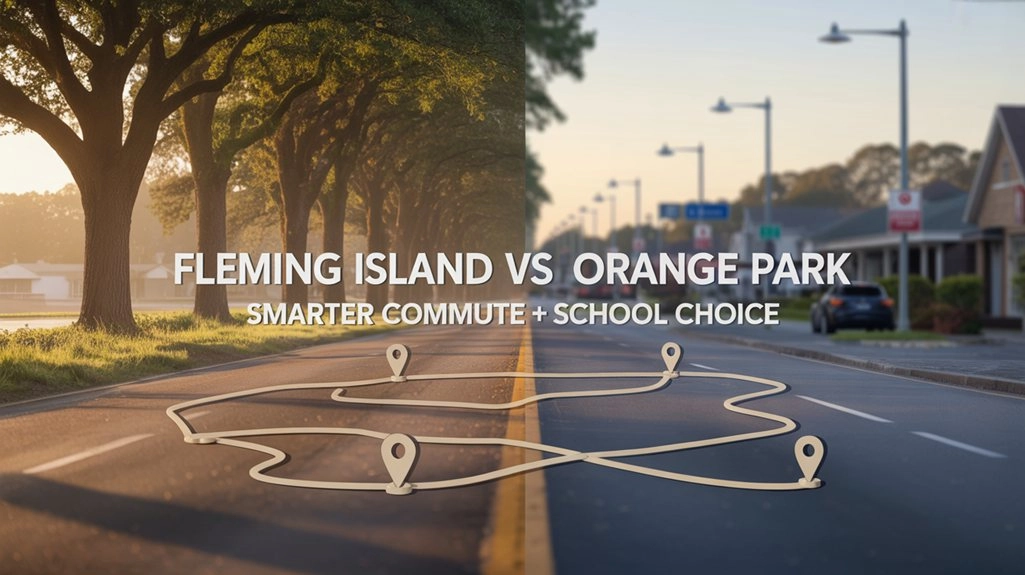
If you’re cross-shopping Fleming Island and Orange Park, you’re not really debating “which one is nicer.” You’re choosing a weekday pattern: commute routes, school logistics, and where traffic reliably slows down. This comparison is written for homebuyers trying to pick the better day-to-day fit—without turning it into a rabbit hole.
Both areas can make sense for real estate decisions in Clay County. The difference is how your routine behaves when it’s tight: mornings, the pickup window, and the stretch between “one quick stop” and “we’re late now.”
If you’re still deciding at the bigger level (not just these two), this overview helps you zoom out: Jacksonville vs Clay County vs St Johns County: How to Choose the Right Area.
Orange Park usually wins on access and convenience, while Fleming Island often wins on a cleaner daily loop—until US-17 or CR 220 tightens up during the school + commute overlap.
Orange Park movement is built around Blanding Blvd (SR 21), Kingsley Ave (SR 224), and US-17 / Park Ave, with I-295 doing the big connecting. You get more routes, but you share them with a lot of households at the same times.
Fleming Island day-to-day leans hard on US-17 and CR 220. When those run normally, the routine is straightforward. When they don’t, detours can be limited, so delays feel bigger.
In both areas, the day-to-day swing factor is usually how many lights and merges you hit before you reach the “real” connector (I-295, US-17, or CR 220). A home that’s only a few minutes closer to a clean access point can feel like a totally different routine.
Most days come down to I-295 and Buckman Bridge flow. The better fit is usually the address that gets you onto I-295 with fewer “starter miles.”
Orange Park often feels simpler for this direction if you’re already close to US-17 or Blanding. Fleming Island can work, but usually adds more dependence on the same connectors.
Both can work. The deciding factor is often the afternoon: test your real drive home, then add the pickup window on top of it.
From either area, your day is usually tied to I-295 and what the Buckman Bridge is doing at your hours. Orange Park can feel closer if you’re positioned well for beltway access. Fleming Island can still be very workable, but when US-17 is already stacked as you start your drive, you feel it immediately.
This is a common reason people choose Orange Park: the routes can be more direct depending on your pocket, and you may have more practical ways to connect without committing to one corridor early. Fleming Island isn’t “wrong” here, but it can add more dependence on the same roads before you’re truly moving in the right direction.
Both areas can do this commute. The real question is which one behaves better when you stack it with school pickup and one stop on the way home. Fleming Island commuters often feel the squeeze earlier because US-17 and the beltway do so much of the heavy lifting. Orange Park can bog down too, but some pockets give you more than one practical path to I-295.
When you’re looking at a specific home, test the drive from the driveway to your main connector at peak time. That first 5–10 minutes is where the “easy commute” claim usually holds up or falls apart.
Run this at your real departure time. It tells you if the morning is workable without forcing an earlier routine than you’d actually keep.
This is the real test. Pickup windows are less flexible than departure times, and they expose traffic pain quickly.
Do this with exact addresses, not the neighborhood name. Save three pins in your map app: the home, the school, and your work destination. If one area consistently turns the afternoon into a tight window, that’s the version of “traffic” you’ll live with all school year.
Morning traffic is often manageable with a small schedule shift. The pickup window is harder to move. If you’re testing one thing before choosing an area, test the afternoon.
Before you commit to a real estate search area, pull up live traffic on a normal weekday and look at your actual corridors. This keeps the decision grounded in what you’ll drive, not what you hope will be fine.
Fleming Island and Orange Park are both served by Clay County District Schools, which is why families cross-shop them. But in real life, the deciding factor isn’t a chart. It’s logistics: the drop-off line, the pickup window, and whether you can get home without crossing the busiest corridor at the worst time.
Can you reach school without crossing the busiest corridor right at peak?
Does pickup stack with the same traffic you need to get home?
Can you add one stop without doubling back through a bottleneck?
Verify the address → assigned school. That’s what matters for your home search. Don’t rely on a listing blurb or “it should be zoned for” assumptions.
If a specific school is non-negotiable, verify zoning by address and confirm current policies with the district. School boundaries and policies can change, and you don’t want your real estate decision resting on “probably.”
If flood zones are part of your decision, this guide is the clean next step: Flood Zones in Northeast Florida: How to Check a Property and What It Means.
If your life runs on convenience—appointments, school schedules, errands, and quick access to major routes—Orange Park often fits, as long as you’re honest about busy corridor traffic being part of normal weekdays.
If you want a routine that feels more contained—where daily life stays closer to home and the loop is simpler most days—Fleming Island often fits, with the trade-off that US-17 and CR 220 timing can decide whether afternoons feel smooth or tight.
Pick two homes you’d actually buy—one in Fleming Island and one in Orange Park—and run the weekday test from the exact addresses. Once you do that, the decision usually stops being theoretical. Then explore real estate in Fleming Island or Orange Park based on the routine you want to live with.
Want the deeper daily-life breakdown for each side? These two stay focused and practical: Living in Fleming Island: Daily Life, Schools, and the Drive-Time Trade-Off and Living in Orange Park, FL: Daily Life, Commutes, and the Convenience vs. Crowds Trade-Off.
It depends on where you work, but the pattern is consistent: Orange Park often feels easier for beltway access and Westside routes, while Fleming Island often feels simpler day-to-day when your routine stays close to US-17 and CR 220.
The most reliable answer is the weekday two-trip test from the exact address. The afternoon run is usually the deciding one.
Verify by address using Clay County District Schools tools. If a specific school is non-negotiable, confirm current policy details with the district so you’re not relying on assumptions.
Use official traffic maps on a normal weekday and look at your actual corridors at your real commute hours. You’re trying to see what’s normal, not what happens on a perfect day.
Test the afternoon: work → pickup window → home from the exact address. If one location keeps turning that window into a squeeze, you’ll feel that stress all year.














It depends on where you work, but the pattern is consistent: Orange Park often feels easier for I-295 access and Westside / NAS Jax routes, while Fleming Island can feel simpler day-to-day when your routine stays close to US-17 and CR 220.
If you want the most honest answer, run a weekday “two-trip” test from the exact address: morning drop-off → work, then work → pickup window → home.
The most common weekday slowdowns show up on Blanding Blvd (SR 21), especially around major intersections like Wells Rd, plus the Kingsley Ave (SR 224) connectors and the ramp areas feeding I-295.
Orange Park can be very convenient for errands, but a lot of households share the same commercial corridors at the same time—especially afternoons.
Most bottlenecks are tied to US-17 and CR 220, especially when school release overlaps with commute traffic and errands.
Fleming Island often feels more contained for day-to-day life, but because there are fewer main corridors, incident days can reshape the routine quickly.
Verify it by address using Clay County District Schools’ zoning tools, then confirm any policy questions directly with the district if a specific campus is non-negotiable.
Use official traffic tools to see whether delays are routine or incident-driven. Then run your route at your real start and end times for a normal weekday.
Do the weekday two-trip test from the exact address: (1) driveway → school drop-off → work, and (2) leave work → pickup window → home. The afternoon run usually makes the better fit obvious.
If one address consistently forces you into a tight pickup window, that’s a daily stressor you’ll feel all school year—not just once.
Want the “daily life” version of each area? Start here: Living in Fleming Island: Daily Life, Schools, and the Drive-Time Trade-Off and Living in Orange Park, FL: Daily Life, Commutes, and the Convenience vs. Crowds Trade-Off.