

TL;DR
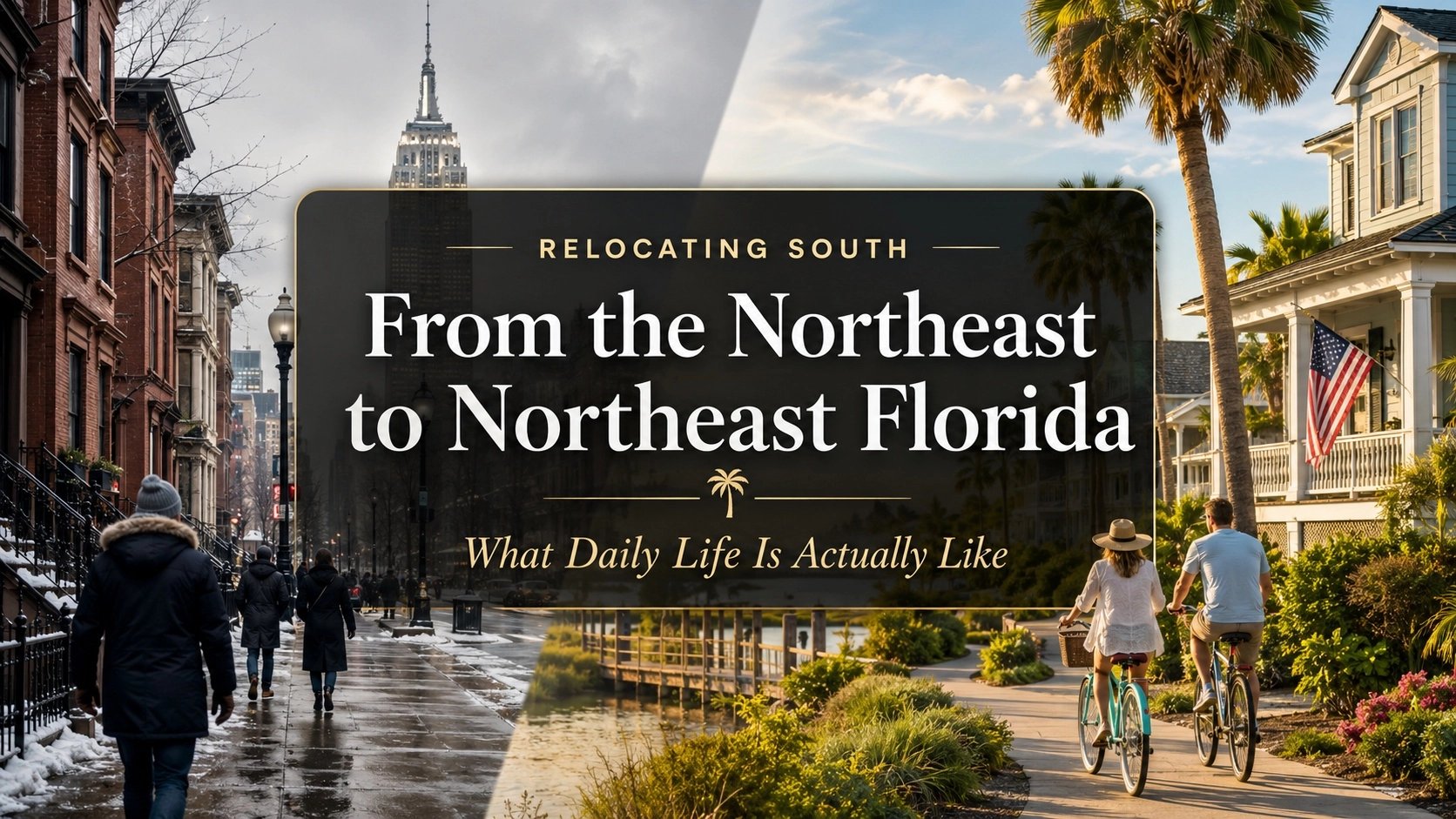
Moving from the Northeast to Northeast Florida is less about weather and taxes than daily routine. Jacksonville, the Beaches, St. Johns County, Clay County, and Nassau County all feel different once you factor in commute patterns, school assignments, errands, storm prep, insurance, and pace of life. The best fit depends on whether you want urban walkability, beach access, master-planned convenience, more space, or a slower small-town routine.
Why Moving to Northeast Florida Feels Different Than Most Florida Guides Suggest
Most Florida relocation guides start with the obvious things: warmer winters, no state income tax, beaches, and more outdoor time. Those are real reasons people move here, but they do not tell you what daily life actually feels like after you unpack.
The bigger adjustment for many Northeast transplants is the routine. Errands work differently. Driving replaces train schedules and walkable town centers in many areas. School decisions are more address-specific than county names suggest. Storm prep becomes part of homeownership. Insurance matters more than buyers expect. And the pace of life can feel noticeably slower, especially if you are coming from New York, New Jersey, Boston, Philadelphia, or another high-urgency metro.
Northeast Florida is also not one lifestyle. Living in Riverside does not feel like living in Nocatee. Jacksonville Beach does not feel like Fleming Island. Fernandina Beach does not feel like St. Augustine or San Marco. The First Coast is a set of very different daily routines, and choosing the wrong one is where relocation regret usually starts.
For a broader regional orientation before you narrow the search, this overview of moving to Northeast Florida is a useful starting point.
The First Coast Is Not One Lifestyle
Northeast Florida is usually talked about as one region, but day to day it behaves more like several smaller worlds connected by highways, bridges, rivers, beaches, and school districts. That matters when you are moving from the Northeast because you may be used to choosing by town name, train line, or commute corridor. Here, the county, road pattern, school zone, and neighborhood style all shape the routine.
The main areas most relocating homebuyers compare are Jacksonville, the Jacksonville Beaches, St. Johns County, Clay County, and Nassau County. Each one can work well for the right household. Each one can also feel wrong if you choose it for the wrong reason.
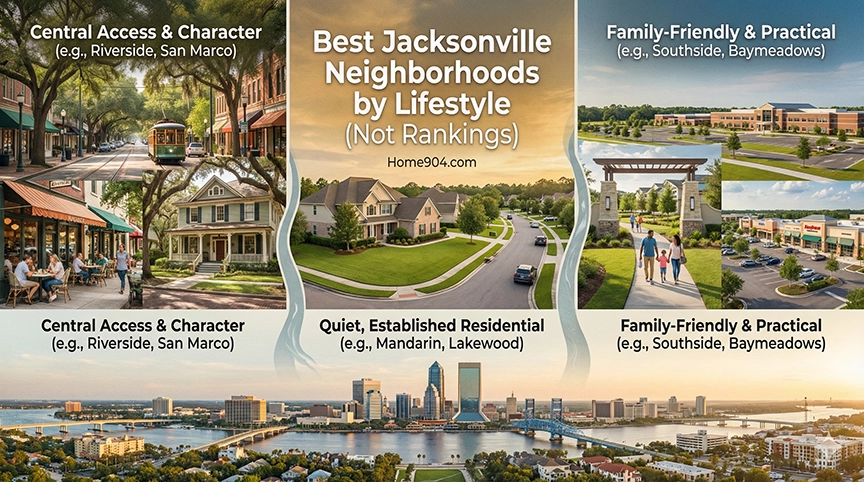
Riverside, San Marco, Five Points, and nearby urban neighborhoods are the closest fit for buyers who want restaurants, arts, coffee, walkable pockets, and shorter access to Downtown Jacksonville.
Jacksonville Beach, Neptune Beach, Atlantic Beach, and Ponte Vedra Beach offer coastal daily life, but each has a different pace, price structure, parking reality, and tourist-season feel.
Nocatee, Fruit Cove, Julington Creek, Ponte Vedra, and St. Augustine-area communities often appeal to families focused on schools, newer homes, planned amenities, and suburban structure.
Orange Park, Fleming Island, Middleburg, Green Cove Springs, and Oakleaf tend to offer more space, a more car-based routine, and a quieter suburban or semi-rural feel.
Fernandina Beach, Amelia Island, and Yulee offer a mix of coastal small-town life, resort influence, growing suburban areas, and a slower north-of-Jacksonville routine.
What Feels Different Day to Day After Moving From the Northeast
The first few weeks often feel easy. The weather is warmer, the roads are wider, and the pace feels less sharp. The deeper adjustment usually shows up after the novelty fades and ordinary routines settle in.
In the Northeast, many people build their week around tight geography: a train line, a walkable downtown, dense errands, shorter distances between services, or a faster social and professional pace. In Northeast Florida, daily life often spreads out. The grocery store may be easy, but the specialist doctor, school activity, beach dinner, airport run, or cross-town appointment may involve a real drive.
That is not automatically a negative. Many people move here because they want more space, less compression, and a less frantic rhythm. But it can surprise buyers who expect Florida to feel like a cheaper version of the Northeast with palm trees. It is a different pattern altogether.
The pace is slower, and that can feel good or strange
The slower pace is one of the biggest daily-life changes. Conversations in line may take longer. Service interactions can feel less rushed. Drivers may not move with the same urgency. Neighbors may stop to talk. Weekends may feel less scheduled, especially outside the urban and beach cores.
For some Northeast transplants, that feels like relief. For others, it feels inefficient at first. The adjustment usually depends on whether you came here wanting a slower rhythm or simply wanting lower costs and better weather.
Errands often take more driving than expected
Errands are one of the first practical differences people notice. In Riverside or San Marco, you may still be able to walk or make short hops for coffee, dinner, or small errands. In Nocatee, you may handle many basics inside the community. In Clay or Nassau, you may gain space but spend more time driving between stops.
That is why “nice area” is not enough. A great house can still create a frustrating week if every errand, school activity, dinner plan, and appointment pulls you in a different direction.
How Driving and Commutes Change
Northeast transplants who used commuter rail, subway systems, dense road networks, or walkable downtowns often underestimate how car-based Northeast Florida can be. Public transit exists, but for most suburban homebuyers it is not the backbone of daily life.
Here, the commute question is not just distance. It is route, bridge, highway access, school drop-off, peak-hour timing, and which side of the river or county line you live on. A drive that looks simple on a map can feel very different when it becomes the thing you do every weekday.
Jacksonville can be easy or spread out depending on where you live
If you live in Riverside, San Marco, Avondale, Murray Hill, or another central Jacksonville area, access to Downtown, nearby restaurants, and everyday services may feel relatively simple. You are still likely to drive, but the distances can stay manageable.
If you live farther out, the region can feel much more spread out. A home in Nocatee, Fleming Island, Yulee, or Middleburg may offer space, schools, newer homes, or quieter surroundings, but the drive pattern becomes part of the decision.
The commute has to match the actual job location
“Close to Jacksonville” does not mean much by itself. Jacksonville could mean Downtown, Southside, Mayo Clinic, the Beaches, JAX airport, NAS Jacksonville, Mayport, or a job center near I-295. Each one changes the right location.
St. Johns County may work well for one household and feel stretched for another. Clay County may be practical for a westside or NAS Jacksonville routine but less convenient for a Beaches-focused life. Nassau County may feel calm and spacious until the commute becomes a daily I-95 commitment.
Urban Jacksonville, San Marco, Riverside, Avondale, and nearby Duval neighborhoods often make more sense if your work life is tied to Downtown or the urban core.
The Beaches, Ponte Vedra, Nocatee, and parts of St. Johns County may work better if your routine points toward the Southside, Mayo, or coastal side of Jacksonville.
Orange Park, Fleming Island, and parts of Clay County may fit better when the week points west or southwest of Jacksonville.
Remote workers have more flexibility, but they still need to test airport access, errands, school logistics, and how often they will actually leave the neighborhood.
For a closer look at one Clay County commute pattern, this guide to living in Orange Park and daily commute reality is a useful next step.
Schools and Neighborhood Fit: Why the Address Matters More Than the County Name
Families moving from the Northeast often start with district reputation. That is understandable, especially when comparing St. Johns County, Clay County, Duval County, and Nassau County from a distance. But district names only get you so far.
In Northeast Florida, the exact address matters. School zones, programs, magnet options, future boundary changes, commute patterns, and after-school logistics can all affect whether a neighborhood works for your family.
St. Johns County is popular, but still address-specific
St. Johns County has a strong school reputation, and that is one of the main reasons many Northeast families look at Nocatee, Ponte Vedra, Fruit Cove, Julington Creek, and other nearby communities. But buyers should still verify the exact assigned schools before making a school-driven offer.
Not every address works the same way. A community name, listing description, or general district reputation is not enough. Use official school-zone tools and confirm the current assignment for the specific home.
Clay and Duval can offer strong fits with more address-level homework
Clay County can be a strong fit for families who want more space, suburban routines, and school options that may work well without the same St. Johns County premium. Fleming Island, Oakleaf, Orange Park, and nearby areas each need their own check, but they should not be dismissed just because they are not St. Johns County.
Duval County requires even more neighborhood-level research. Jacksonville is a large city with very different school patterns from one area to the next. Riverside, San Marco, Mandarin, the Southside, and other Duval areas can create very different school and commute realities.
For families comparing the major county-level trade-offs, this Jacksonville vs. Clay County vs. St. Johns County guide helps frame the cost, school, and commute differences.
Weather, Storms, Insurance, and the Real Cost of Coastal Living
The weather is one of the reasons people move here, but it is also one of the things that changes homeownership. Northeast Florida has mild winters, long hot summers, regular afternoon storms in the warmer months, and a storm-prep mindset that may be new if you are coming from the Northeast.
The beach lifestyle is real. So are wind, flood, heat, humidity, insurance quotes, roof age, drainage, and hurricane-season planning. Those details do not mean you should avoid coastal or near-coastal areas. They mean you should understand the full cost and maintenance picture before you choose a home.
Coastal areas need address-specific insurance checks
Jacksonville Beach, Neptune Beach, Atlantic Beach, Ponte Vedra Beach, Amelia Island, Fernandina Beach, and low-lying river or marsh-adjacent areas may carry different insurance considerations than inland neighborhoods. Flood zone, elevation, roof age, construction type, wind mitigation, and proximity to water all matter.
Do not assume insurance based on the city or neighborhood name. Two homes near each other can quote differently because the risk is property-specific. Before you make an offer, get an address-specific insurance quote and check the flood zone.
Summer feels different than vacation weather
Northeast Florida is not year-round postcard weather. Winters are mild and often beautiful. Spring and fall can be comfortable. Summer brings heat, humidity, storms, and a different pace to outdoor life.
That matters if you are choosing a beach area or outdoor-focused community. The beach may be close, but the best time to use it may shift by season, weather, parking, visitors, and your tolerance for heat.
Get quotes tied to the exact address, including wind and flood considerations where relevant.
Check FEMA flood zone, local drainage patterns, elevation, and stormwater behavior before assuming the risk is low.
Master-planned communities may include HOA dues, CDD assessments, and other community costs that change the full monthly payment.
Roof age, HVAC age, windows, drainage, salt-air exposure, and older-home systems all matter in a Florida ownership budget.
For a deeper look at flood-zone checks, this guide to flood insurance by address in Northeast Florida explains what buyers should verify before closing.
Which Northeast Florida Areas Feel Most Familiar to Northeast Transplants?
Different parts of the First Coast feel familiar to different kinds of Northeast transplants. Someone coming from Brooklyn or Boston may respond differently than someone coming from suburban New Jersey, Connecticut, Long Island, or a smaller Pennsylvania town.
The right fit is usually less about where you are from and more about the daily rhythm you want to keep or leave behind.
Urban Jacksonville feels most familiar if you want walkability and local energy
Riverside, San Marco, Five Points, Avondale, and nearby Jacksonville neighborhoods tend to feel more familiar to people who like older homes, restaurants, coffee shops, arts events, local businesses, and some walkable daily life.
These areas are not Northeast cities, but they offer the closest First Coast version of urban neighborhood texture. The trade-off is older housing stock, more address-specific school research, and less of the newer master-planned convenience found in St. Johns County.
The Beaches feel familiar if you want coastal energy
Jacksonville Beach, Neptune Beach, Atlantic Beach, and Ponte Vedra Beach often appeal to people coming from coastal parts of the Northeast or Mid-Atlantic. The beach can become part of the week, and the social energy can feel more active than inland suburbs.
The trade-off is cost, parking, seasonal crowds, insurance, and the reality that living near the beach is not the same as being on vacation. It is still regular life, with grocery runs, traffic, work, school, storms, and bills.
St. Johns County feels familiar to suburban Northeast families
Nocatee, Fruit Cove, Julington Creek, and other St. Johns County areas may feel familiar to buyers coming from planned or high-performing suburban school markets in the Northeast. The routines are family-oriented, car-based, organized, and often centered around schools, sports, amenities, and neighborhood structure.
The trade-off is that daily life can feel more managed and less spontaneous. HOA/CDD costs, school zoning, commute routes, and the distance from urban Jacksonville all need to fit your household.
Clay and Nassau feel familiar if you want space and a slower pace
Clay County and Nassau County can make sense for buyers who want more space, quieter surroundings, a smaller-town feel, or less urban energy. Fleming Island, Orange Park, Middleburg, Yulee, Fernandina Beach, and Amelia Island each create a different version of that slower First Coast routine.
The trade-off is more driving. Errands, restaurants, services, airports, specialty medical care, and certain job centers may take more planning. That is not a flaw if you want space and quiet, but it needs to be part of the decision.
Start with Riverside, San Marco, Five Points, Avondale, and nearby Jacksonville neighborhoods.
Compare Jacksonville Beach, Neptune Beach, Atlantic Beach, and Ponte Vedra Beach carefully by parking, cost, insurance, and daily pace.
Look closely at Nocatee, Fruit Cove, Julington Creek, Durbin, and other St. Johns County communities, but verify school assignment and full monthly costs by address.
Clay and Nassau may fit well, especially if you are comfortable with more driving and a less urban everyday pattern.
Who Adjusts Well, and Who Struggles?
The people who adjust well usually choose a routine, not just a house. They know whether they want walkability, beach access, schools, quiet, land, or a managed community. They test the commute. They verify insurance. They check schools by address. They accept that Northeast Florida moves differently than the Northeast.
The people who struggle usually choose based on one attractive idea: cheaper taxes, warmer weather, a bigger house, beach proximity, or school reputation. Those things matter, but none of them can carry the decision alone.
You may adjust well if:
- You want a slower pace and do not need Northeast-style urgency in daily interactions.
- You are comfortable with a car-based routine in most suburban areas.
- You verify insurance, schools, commute, flood zone, and HOA/CDD costs before making an offer.
- You choose the area that fits your normal week, not just the one that feels best on vacation.
- You understand that each county and neighborhood has its own version of First Coast life.
You may struggle if:
- You expect dense Northeast-style walkability in every desirable neighborhood.
- You choose a coastal area without understanding insurance, parking, heat, storms, and seasonal crowds.
- You buy in a school-driven area without confirming the exact assigned schools.
- You assume no state income tax automatically means lower total monthly cost.
- You want privacy and flexibility but choose a highly managed, highly social master-planned community.
The Bottom Line: Choose the Routine, Not the Florida Fantasy
Moving from the Northeast to Northeast Florida can be a very good decision, but it works best when you choose the right daily routine. The weather, taxes, beaches, and slower pace are only part of the story. The real fit comes from how your week feels after the move.
If you want urban energy, start with Jacksonville neighborhoods like Riverside, San Marco, Five Points, and Avondale. If you want beach access, compare the Beaches and Ponte Vedra with insurance and seasonal traffic in mind. If schools and planned convenience matter most, look closely at St. Johns County but verify the exact address. If space and quiet matter more, Clay or Nassau may be the better fit.
The First Coast is not one place. It is a set of different routines connected by water, bridges, highways, beaches, and county lines. The best move is the one where your commute, school needs, monthly cost, storm comfort, and cultural pace all make sense together.
For a side-by-side comparison of the most common area decisions, this Jacksonville vs. Clay County vs. St. Johns County guide can help you compare cost, schools, commute, and lifestyle before you choose where to focus your search.
_0001.jpg)
_0001.jpg)
.png)
_0003.jpg)