

TL;DR
Moving from the Northeast to Northeast Florida changes more than the forecast. A home in central Jacksonville, at the Beaches, in Nocatee, in Clay County, or on Amelia Island can create a very different week. Compare the actual routes to work and errands, any school requirements, summer weather, storm and insurance exposure, and the full cost of the particular home. A county name or Florida mailing address cannot settle those questions for you.
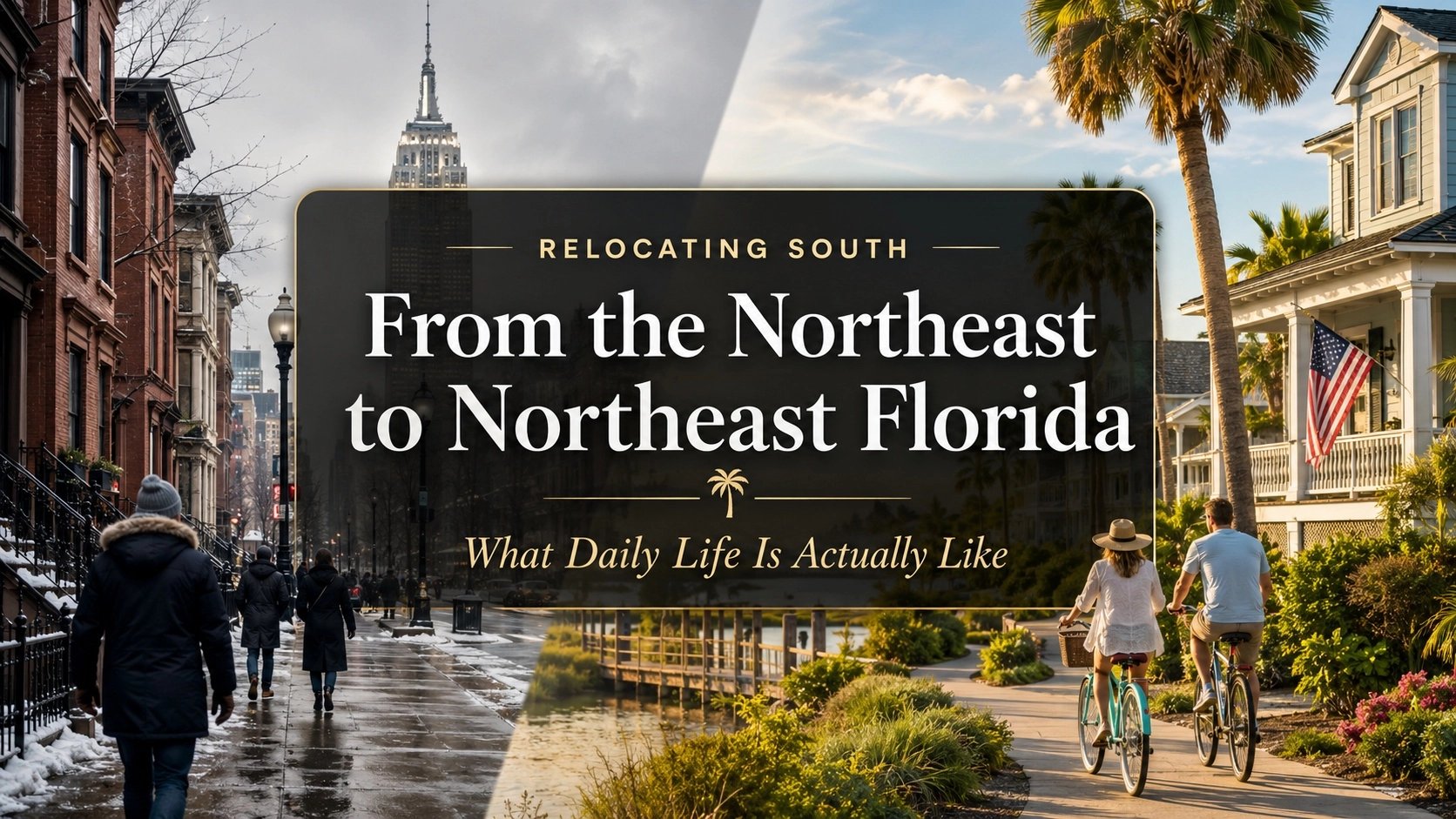
Cover illustration: The contrast between snow and palms is conceptual; it does not identify a particular Northeast Florida street or home.
The Week After You Unpack
Imagine finding a house you love on a sunny Saturday. The porch looks inviting, the beach is on the day's itinerary, and the drive from the airport seemed straightforward. Now picture an ordinary Wednesday: getting to work or an appointment, picking up groceries, making an evening activity, and getting home before the next round of plans. That is the more useful test of a move from the Northeast to Northeast Florida.
Someone arriving from a transit-oriented part of New York or Boston may have to rethink how many trips require a car. Someone arriving from suburban Connecticut, rural Pennsylvania, or upstate New York may already drive for everything. Neither starting point tells us whether Riverside, Fleming Island, Nocatee, Jacksonville Beach, or Yulee will feel familiar. The question is what you want your week to include, and what the road and property actually make possible.
Here, a river, an Intracoastal crossing, a county boundary, or the location of one job entrance can matter more than a neighborhood's promotional description. Jacksonville neighborhoods, planned communities, coastal addresses, and inland towns offer different ways to organize the same everyday tasks.
If you are still getting oriented, the Home904 overview of moving to Northeast Florida provides the broader regional starting point.
One Region, Several Different Maps
The First Coast is a common name for the Jacksonville area and surrounding Northeast Florida communities. Jacksonville is only part of it, and the Beaches are not a single municipality. Jacksonville Beach, Neptune Beach, and Atlantic Beach have their own city governments within Duval County; coastal Ponte Vedra Beach is in St. Johns County. Inland communities may use a Ponte Vedra mailing address without being at the ocean. These distinctions affect which agencies, school district, tax district, and local rules apply to an address.
Riverside, Five Points, Avondale, Murray Hill, and San Marco have distinct pockets of restaurants, shops, older streets, and nearby destinations. Walkable blocks exist, but the usefulness of walking depends on your block and errands; San Marco and Riverside are also on different sides of the St. Johns River.
Beaches Town Center, shared by Atlantic Beach and Neptune Beach at the ocean end of Atlantic Boulevard, is a different destination from the Jacksonville Beach pier area. Ponte Vedra Beach sits farther south in St. Johns County. Compare the particular beach access, parking arrangement, and mainland connection.
Fruit Cove, Julington Creek, parts of Ponte Vedra, and St. Augustine-area communities do not share one road or housing pattern. Nocatee is a master-planned community primarily in St. Johns County, with portions in Duval; its Town Center, residential neighborhoods, and amenity access are different things.
The incorporated Town of Orange Park is smaller than the wider Orange Park mailing area. Fleming Island, Middleburg, Green Cove Springs, and Oakleaf offer different housing and road settings. Oakleaf Plantation is a Clay County census-designated place, while the wider Oakleaf development label is used near the Clay–Duval line.
Fernandina Beach is a city on Amelia Island; the island and the city are not interchangeable. Yulee is on the mainland, while Callahan and Hilliard offer other inland settings. An island outing, a grocery run, and a Jacksonville commute can follow quite different paths.
A mailing label is a useful search term, not a legal boundary. For example, the Town of Orange Park's limits map distinguishes incorporated streets and address ranges. If a home is advertised as Nocatee or Oakleaf, confirm the parcel's county and district records rather than assuming that the community name determines schools, taxes, or amenity rights.
What Changes Between the Weekend Tour and Monday Morning?
A walkable block is not necessarily a walkable week
You might walk out for coffee near Five Points, dinner in San Marco, or shops near Beaches Town Center. Historic areas of St. Augustine and Fernandina Beach offer other places where walking between destinations makes sense. But that does not establish a car-free routine from a particular home. Your preferred grocery store, specialist, worksite, or appointment may be somewhere else entirely.
Even within a coastal municipality, access varies. Jacksonville Beach has separate destinations such as the pier at 503 First Street North and South Beach Park on South Beach Parkway. The city's parking rules identify specific facilities, dates, and resident-registration conditions; owning a home nearby does not make every beach visit parking-free. Fernandina Beach likewise identifies some public beach accesses with parking and others without. The useful question is whether you can reach the place you expect to use, in the way you expect to use it.
Community convenience has an address of its own
Nocatee's Town Center has groceries, dining, and other services, and its community overview describes trails and paths linking neighborhoods with recreation and shopping. That can be appealing when errands and activities align with your home. It does not mean every Nocatee home is a short walk from Town Center or that every recreational facility is open to every property on identical terms. Check actual paths, allowed cart routes, neighborhood association documents, and the drive to destinations outside the development.
Beyond master plans, Fleming Island, Middleburg, and Yulee offer different kinds of residential streets and homes. A bigger yard, an established street, a nearby market, and a neighborhood pool can each be appealing, but they are different advantages rather than interchangeable versions of convenience.
Driving, River Crossings, and the Transit You Can Actually Use
Walkable pockets, neighborhood paths, and bus routes exist alongside long cross-town connections. The time and effort of a trip can depend on a river crossing, highway interchange, or transit transfer—not just the distance between two points.
Choose the corridor before guessing at the commute
Atlantic Boulevard, Beach Boulevard, and J. Turner Butler Boulevard (JTB/SR 202) are separate mainland-to-Beaches routes across the Intracoastal Waterway. I-95 and I-295 connect other parts of the region, but their interchanges don't erase the distance between your house, the destination's entrance, and your intermediate stops. Nocatee Parkway connects U.S. 1 with Palm Valley Road toward the coast; it does not have a direct I-95 interchange. From I-95, the developer's published approach uses County Road 210 and U.S. 1.
On the west side, U.S. 17/Roosevelt Boulevard and Blanding Boulevard create different Clay County approaches to Jacksonville. The Buckman Bridge matters if the route crosses the St. Johns River on I-295, but it is not required for every Clay-to-Jacksonville trip. North of town, the approach from I-95 Exit 373 onto SR 200/A1A crosses the Intracoastal to Amelia Island. The right route depends on which side of those connections your address and destination sit.
“I work in Jacksonville” leaves out the most important part
Downtown Jacksonville, the Southside, Mayo Clinic, Jacksonville International Airport, Naval Air Station (NAS) Jacksonville, and Naval Station Mayport are different destinations. Mayo's Jacksonville campus is at 4500 San Pablo Road on the mainland side of the Intracoastal, with an approach from JTB and San Pablo Road; it is not on the beach island. NAS Jacksonville lies west of the St. Johns River off U.S. 17, while Mayport is a separate naval installation near the coast. The airport is north of the urban core at 2400 Yankee Clipper Drive.
That changes how you compare homes. An Orange Park address might deserve a look for a regular NAS Jacksonville trip, but that does not establish its suitability for Mayport. A coastal home might fit frequent beach visits yet still make an airport trip a significant event. Map the actual work building, parking entrance, or permitted base gate, check live conditions through Florida 511, and test both the outgoing and return journey.
Transit deserves its own real-world check. The Jacksonville Transportation Authority (JTA) lists fixed-route service on corridors such as Beaches/Town Center, San Jose, Mayport, and Park/Blanding, with schedules and a trip planner to check connections. Clay Community Transportation has scheduled routes and reservation-dependent flex deviations; St. Johns' Sunshine Bus serves the St. Augustine urbanized area with separate qualified demand-response service. Nassau Transit describes eligibility-based Transportation Disadvantaged trips, not an unrestricted countywide shuttle. Routes, transfers, stop access, eligibility, and the last trip home determine whether transit works for you.
For a closer look at the westside pattern, read living in Orange Park and its everyday commute trade-offs.
If Schools Matter, the Search Starts at the Address
School choices can influence where you look, but county reputation is too blunt a tool for selecting a home. There are four public school districts to investigate here—Duval, St. Johns, Clay, and Nassau—and the starting point is the student's actual residential address, grade, and school year.
A community name does not establish a school assignment
Suppose you find two Nocatee homes advertised with a Ponte Vedra address. Because Nocatee extends into both St. Johns and Duval counties, you cannot assume those homes use the same school district. The distinction also matters around Oakleaf and broad Orange Park mailing areas. Check the specific residence in the district's own tools: Duval school location, St. Johns attendance zoning, Clay school zones, and Nassau enrollment and zone lookup.
School boundaries can change as districts add capacity. St. Johns, for example, provides a special 2026–27 eighth-grade locator for addresses affected by new schools opening initially with grades K–7. A map result should lead to a current confirmation with the district for the particular grade and school year, not a guess based on the nearest campus or a listing description.
Choice programs, registration, and the bus are different questions
Being zoned for a school, qualifying to register, receiving a choice or magnet seat, and having transportation are not interchangeable. St. Johns' controlled open enrollment depends on an application window, seat availability, grade-level capacity, and selection conditions; the district says parents or guardians provide transportation for that option. In Nassau, the 2026–27 controlled open enrollment plan has set application windows and generally offers transfers to schools with available room; requests to schools at capacity require additional principal and school-board approval. Under that plan, families must arrange transportation for students attending outside their assigned zones. Other districts have their own program rules. If a particular program matters, ask the district about eligibility and the school's ability to serve the student's needs before counting on a transfer.
Moving paperwork is part of the calendar, too. Proof of residence, school records, immunization documentation, and a physical may be required, with details varying by district and circumstance. Nassau's registration materials, for example, distinguish homeowner, renter, and shared-residency documents; St. Johns says families cannot register a child at a future home address until they have a signed closing statement or current lease. Add school transport, activities, and after-care to the route test—not only the morning commute.
Read the Jacksonville, Clay County, and St. Johns County comparison for more on those areas’ routes, schools, and costs. For Nassau, use its own district and transportation information.
The Season Outside Your Window—and the House You Need to Maintain
A mild January and a humid July ask different things of your schedule
At Jacksonville International Airport, the Florida Climate Center's 1991–2020 normals show an average January high and low of 65.5°F and 42.9°F, compared with 91.9°F and 73.2°F in July. June through September are also much wetter on average than January. Those are long-term figures for one weather station, not a promise about the forecast, the Beaches, or how you will feel outdoors.
The practical change may be when you choose to walk, work in the yard, exercise, or visit the beach. Summer heat and humidity, along with thunderstorms, can move activities into earlier hours or indoors. Winter is generally milder than in much of the Northeast, but a freeze is still possible: Jacksonville's airport recorded 29°F on a January morning in 2023. Think about shade, cooling equipment, drainage, and your own tolerance for the seasons as part of the housing decision. The Florida Climate Center's Jacksonville normals provide the longer view.
Flood zones, evacuation zones, and insurance quotes answer different questions
NOAA identifies June 1 through November 30 as Atlantic hurricane season. Preparing a household plan, checking supplies, and reviewing insurance before a storm threatens are sensible steps whether a home is near the ocean or inland. That doesn't mean every address has the same exposure. A FEMA flood-zone designation addresses mapped flood hazard; a county evacuation zone helps officials plan movement during storm threats; and an insurer evaluates the proposed home and policy. One cannot substitute for the others.
Look up the actual address in the FEMA Flood Map Service Center and the relevant county's current evacuation resources. A Zone X designation is not a guarantee that a property cannot flood. Ask about elevation, local drainage and water history, roof condition, construction and wind-mitigation details, and obtain address-specific coverage quotes. Standard homeowners insurance generally does not cover flooding. Florida's insurance regulator explains that private flood protection can be a separate policy or an endorsement to homeowners coverage. Compare coverage, exclusions, deductibles, waiting periods, and lender requirements.
This matters on Amelia Island, in Jacksonville Beach or Ponte Vedra Beach, along rivers and marshes, and at inland addresses with drainage concerns. The Home904 flood-insurance-by-address guide goes deeper on those property checks.
What Will the Move Actually Cost You?
No Florida personal income tax is a real distinction. It is not a calculation of what your household will save, and it says nothing by itself about what a particular roof, tax bill, association, or daily driving pattern will cost.
Florida's income-tax rule is straightforward; your former state's may not be
Florida does not impose an individual state income tax or require an individual Florida income-tax return. Federal obligations and possible taxes tied to a former state are separate. As one example, New York's tax guidance distinguishes domicile, part-year residence, nonresident New York-source income, and certain out-of-state telecommuting circumstances. Rules for New Jersey, Massachusetts, Connecticut, Pennsylvania, and other states are not interchangeable with New York's.
Before treating a tax difference as spending money, check your own transition date, income sources, former-state rules, and any applicable business or employment arrangements with a qualified tax professional. Then compare the complete cost of living in the homes you are considering.
The seller's property-tax bill is not your future tax estimate
A seller’s Florida property-tax bill may reflect a homestead exemption and years of accumulated Save Our Homes assessment protection. When ownership changes, those protections do not simply carry over to an unrelated buyer moving from out of state. Your estimate depends on the anticipated purchase value, taxing district, applicable exemptions, and any non-ad valorem assessments—charges based on a service or unit rather than the property's value. Check with the county property appraiser instead of treating the listing's last tax bill as your own.
For example, the St. Johns County Property Appraiser's estimator uses available parcel data and can include non-ad valorem charges such as applicable CDD and solid-waste assessments. Its figures are estimates based on available rates and assessments, not a final future bill. Read what is already included before adding another assessment to your monthly worksheet.
An HOA is private; a CDD is local government
Community development districts (CDDs) and homeowners or property-owners associations (HOAs/POAs) may both affect a home's costs, but they are different entities. A CDD is a public special-purpose government that can levy assessments for infrastructure debt and continuing operations and maintenance. An HOA or POA is a private association with its own dues, governing documents, rules, and maintenance responsibilities. Paying off a CDD's bond debt does not automatically eliminate ongoing operations costs.
Nocatee makes the distinction tangible: the Tolomato CDD's fiscal 2027 information separates debt from operations and maintenance, and different residential neighborhoods have their own association contacts and rules. Oakleaf Plantation's association identifies separate Double Branch and Middle Village CDDs alongside separate property-owners associations. Neither the development name nor a brochure proves a particular parcel's assessments or recreational privileges. Read the relevant district, association, and property documents before assigning a fee or benefit to the house.
Build one complete budget, without counting the same bill twice
The mortgage principal and interest are only the beginning. Include any mortgage insurance, estimated buyer property taxes, homeowners and applicable flood coverage, association charges, CDD or other assessments, utilities, and an allowance for the home's repair and replacement needs. A roof, HVAC system, drainage issue, or coastal exposure can matter in an older house or a newer one. A repair reserve is money you plan to set aside, not an extra invoice from the county.
Your lender's Loan Estimate may already include taxes and insurance in the monthly escrow payment, while showing some assessments separately. Count each expense once. Keep one-time down payment, closing costs, movers, and any temporary-housing overlap separate from the recurring monthly picture.
Use the parcel's taxing district and likely purchase value; confirm which CDD or other non-ad valorem charges are already included.
Review homeowners, wind and applicable flood coverages, exclusions, deductibles, and property-condition assumptions.
Separate CDD assessments from HOA/POA dues; check what they maintain, any restrictions, and the home's eligibility to use amenities.
Reconcile escrow with other expenses, then account for inspections, roof/HVAC condition, maintenance responsibilities, and cash needed at closing.
Deciding Between Two Good-Fit Homes
Two houses can both be appealing for completely different reasons. Once you have compared routes, school requirements if relevant, and actual ownership obligations, the question is no longer which area is supposedly best for Northeast transplants. It is which advantages you will use and which compromises you can live with.
Separate everyday benefits from occasional ones
Maybe one address puts a restaurant or walking path within easy reach while another gives you a home layout or outdoor space that fits the way you spend time. The first may matter more if you use that nearby destination often; the second may matter more if you spend much of your time at home. Even beach access has practical differences: Fernandina Beach's public access list distinguishes entrances with parking from those without. An attractive feature is not automatically one you will use.
Be clear about the commitments you are taking on
A neighborhood may suit a school plan but add a pickup responsibility. A community may provide recreation you value, with association rules, dues, or public district assessments attached to the particular property. Newer and older homes alike can require meaningful insurance and maintenance spending. These are not reasons to rank counties or housing styles for everyone moving from the Northeast. They are part of deciding whether a specific home's benefits justify its continuing obligations.
Moving south does not have to make every part of life slower, cheaper, or more convenient. A good fit is the home whose advantages hold up on an ordinary Wednesday, long after the sunny Saturday showing.