

_0002.jpg)

New - 1 Hour Ago



TL;DR
Orange Park, FL carries a well-earned reputation as affordable and family-friendly, but daily life in Orange Park looks completely different depending on which block you land on — a home near Blanding Boulevard gives you errand efficiency at the cost of corridor congestion, a waterfront or side-street address delivers genuine calm at the cost of longer drives for everything, and a master-planned community like Oakleaf Plantation organizes your kids' routines at the cost of a longer Jacksonville commute and a CDD assessment on your tax bill. Confirm your school zone with Clay County District Schools, drive your commute route during school-year morning hours, and pull the HOA resale disclosure and CDD bond schedule before committing to any specific address.
Every Orange Park relocation article says the same thing — affordable, family-friendly, good schools — but none of them tell you that the family two streets over has a completely different morning than you will. The ZIP code is shared. The daily life is not.
That gap exists because Orange Park, FL isn't one neighborhood with one rhythm. It's three distinct lifestyle zones that happen to share a name. There's the Blanding Boulevard corridor, where commercial density makes errands fast but morning traffic is a real variable. There's the waterfront and side-street zone along the St. Johns River, where the pace is slower and the tradeoffs are measured in grocery-run minutes. And there's the master-planned structure of Oakleaf Plantation, where organized amenities shape the family schedule but the Jacksonville commute is longer and the CDD cost structure requires its own due diligence.
Most relocation research describes Orange Park broadly — affordable, family-friendly, suburban — without explaining how dramatically daily routines shift between these zones. A family choosing a home near a Blanding feeder street is making a different logistical bet than one choosing a quiet riverfront side street or a community like Oakleaf East. The school pickup flow, the commute stress, the errand efficiency, and how much waterfront calm you actually experience day to day all depend on which of those three zones you're in.
It's worth being upfront about one limitation: the available research does not provide resident-level complaints about Blanding Boulevard traffic or how it affects school and daycare runs specifically. What follows draws on documented structural patterns, named community features, and the geographic realities of each zone — not anecdote. That's actually more useful for a decision, because it tells you what to go verify yourself rather than what one person happened to experience.
To understand why the gap between zones matters, start with the corridor that shapes the most Orange Park mornings.
Living close to Blanding Boulevard sounds like a win — everything is minutes away — until you try to do school drop-off and a grocery run on the same morning during rush hour. That's when the corridor's dual identity becomes clear.
Blanding Boulevard anchors Orange Park's commercial life in a way that's genuinely useful for families managing a full week of logistics. The Orange Park Mall area clusters retail, grocery, dining, and services in a concentration that makes Saturday errands efficient. For families whose daily routine depends on quick in-and-out stops — groceries after school pickup, a pharmacy run folded into the afternoon, fast-casual dinner on a weeknight — proximity to the Blanding corridor is a real time asset, not just a map convenience.
Families choosing Orange Park for a generally affordable, family-friendly lifestyle while balancing work commutes and school routines often gravitate toward Blanding-adjacent addresses for exactly this reason. The math looks good on paper: one corridor, multiple stops, done.
The corridor that makes Saturday errands easy is the same corridor that stacks up hardest on Tuesday at 7:45 a.m., and no listing description will tell you that. Homes on feeder streets close to Blanding gain errand convenience but absorb the corridor's morning and afternoon congestion — and when school drop-off timing and Jacksonville commute traffic overlap, those two pressures compound each other in ways that are hard to anticipate from a weekend visit.
Here's the honest trade-off: convenience and access to errands versus quieter, more relaxed waterfront or side-street living. Blanding-adjacent homes win on the first half of that equation and give up the second. Whether that exchange works for your household depends entirely on your specific morning sequence.
Blanding Corridor: The Upside and the Cost
What you gain: Errand efficiency, retail access, proximity to the Orange Park Mall cluster, fast in-and-out logistics for busy family weeks
What you absorb: Peak-hour congestion on Blanding Boulevard, the potential for school-run timing to overlap with Jacksonville commute traffic, corridor noise on feeder streets
What to do before buying: Drive your specific route during school-year morning hours. Confirm your school zone assignment with Clay County District Schools — zone assignment is address-specific, and the school referenced in a listing description may not match the current assigned school for that address.
Published sources do not document specific resident complaints about Blanding traffic affecting school runs, so families evaluating this zone need to test it themselves. Drive the route. Include the school drop-off loop. Do it on a Tuesday during the school year, not a Saturday in July.
If Blanding's convenience comes with a congestion cost you're not willing to absorb, the natural question is whether the quieter alternative — the waterfront and side-street zones — actually delivers the calm it promises. How Blanding-corridor congestion compares to Fleming Island's route dynamics is worth reading if you're weighing both communities side by side.
The St. Johns River view and the golf-cart street are real — but so is the drive to the grocery store when you forgot something for dinner. Waterfront neighborhoods in Orange Park deliver genuine calm, and it's worth being specific about what that calm actually looks like before assuming it fits your routine.
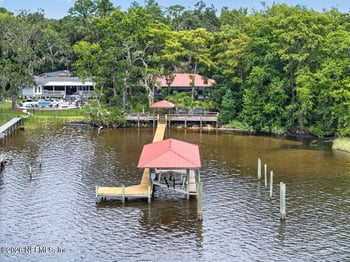
Riverfront and side-street neighborhoods in Orange Park operate at a measurably different pace than the Blanding corridor. Clarke House Park — verify current hours and amenity access with the Town of Orange Park — historically anchors recreational routines in this zone with playgrounds, picnic areas, and river access. Residents using the area's parks and riverfront setting as part of a calmer home-life routine find that this zone supports exactly that pattern: after-school time at the park, weekend boating on the St. Johns River, a neighborhood rhythm that doesn't run through a commercial corridor.
The community spirit in these neighborhoods tends to be quieter and more self-organized than in a master-planned community — neighbors who share a riverfront street rather than a community pool. That's a different social texture, and it suits a different kind of family.
Homes in waterfront zones often feature boat parking and golf-cart-friendly streets, which shapes how families move through the neighborhood for short trips. That pattern has no equivalent in Blanding-adjacent subdivisions. The waterfront calm here is observable — it's in the driveways, the street width, the absence of commercial traffic — not just a marketing description.
But the micro-location friction between that calm and daily errand logistics is exactly what published relocation guides don't document. The honest trade-off is this: waterfront calm means more distance from the Blanding commercial cluster, so grocery runs, pharmacy stops, and school-adjacent errands require deliberate planning rather than opportunistic detours. You're not grabbing milk on the way home from pickup. You're making a separate trip. For some families, that's a reasonable exchange. For others, it accumulates into a daily friction point that erodes the appeal of the setting.
Flood Zone Check — Required for Waterfront Properties
River proximity in Northeast Florida carries address-specific flood risk that cannot be assumed from neighborhood-level descriptions. Before purchasing any property near the St. Johns River, check the specific property's FEMA flood zone designation and confirm current flood insurance requirements with a licensed Florida insurer. Do not rely on community-level generalizations — zone designations vary by parcel. Start your lookup at the FEMA Flood Map Service Center.
This zone fits buyers who prioritize after-school outdoor time, weekend boating, and a slower neighborhood rhythm over errand efficiency. The lifestyle asset is real. But it requires accepting longer drives for daily conveniences — and verifying the flood picture at the specific address before you write an offer.
For families who want organized amenities without the errand distance of the riverfront, there's a third zone — and it changes the daily routine in its own specific way. How Orange Park's waterfront living patterns compare to Julington Creek's river-adjacent neighborhoods is a useful read if you're weighing both sides of the river.
Oakleaf Plantation sells itself on the idea that your kids' entire social calendar is already built into the neighborhood — and for many families, that's exactly true. The community pools, tennis courts, soccer fields, and sports programs managed by CDDs including Double Branch and Middle Village mean that after-school and weekend activities happen within the community rather than requiring separate drives to separate facilities. For families with school-age kids, that's a genuine daily logistics advantage over both the Blanding corridor and the riverfront zones.
Oakleaf Plantation is divided into areas including Oakleaf East and West, with neighborhoods such as Hamilton Glen in Oakleaf West. The amenity structure here is intentional: playgrounds, workout facilities, and organized sports programs are built into the community design, which means the good schools and community spirit that draw families to Orange Park are reinforced by infrastructure that actually supports kid-focused daily life.
Families choosing Orange Park for a generally affordable, family-friendly lifestyle while balancing work commutes and school routines often find that Oakleaf's internal amenity cluster resolves the after-school logistics problem that other zones leave open. Instead of driving to a park or a rec center, the activity is already inside the neighborhood.
Verify current amenity access and community boundary details with the relevant CDD — Double Branch or Middle Village — directly, since master-planned communities can adjust amenity offerings and access rules over time. What the community brochure describes and what the current CDD governs may not be identical.
What the community brochure doesn't show is the CDD line on the tax bill, which varies by neighborhood and bond schedule in ways that two homes on the same street can reflect differently. CDD assessments appear on the property tax bill — they are not a separate monthly fee you'll see at closing, which is exactly why they catch buyers off guard. The available material lacks specific documented pain points around this from Orange Park residents, but the structural reality is consistent across Northeast Florida master-planned communities: the CDD cost is real, it varies by neighborhood and bond payoff stage, and it must be verified at the specific address level before you commit.
Oakleaf CDD Verification Checklist
Oakleaf's distance from Blanding Boulevard and Jacksonville means the Jacksonville commute is longer from this zone than from Blanding-adjacent addresses. The organized-amenity advantage is real, but it only holds if the commute math works. Explore specific Orange Park community listings to cross-reference Oakleaf neighborhood options against other Orange Park zones. And if you want to understand what CDD fees actually look like across Northeast Florida communities before you dig into the Oakleaf specifics, how CDD fees work and when they're worth the cost is a useful primer before you request the bond schedule.
The commute from Orange Park to Jacksonville looks manageable on a map — until you add school drop-off, a bridge backup, and a school-year Tuesday morning. That sequence is where the distance between zones stops being abstract and starts being a daily variable.
Orange Park's role as a bedroom community for Jacksonville means the Jacksonville commute is a daily variable for most households. But the commute experience differs meaningfully depending on whether you live near Blanding Boulevard, in the riverfront zone, or in Oakleaf Plantation — because each zone feeds different routes with different congestion patterns.
Blanding Boulevard and the bridges crossing into Jacksonville are documented congestion points during morning rush hours. There are no direct accounts of commute stress into Jacksonville or route-specific congestion patterns in the available published sources — which means no source documents which specific Orange Park zones add the most time to a Jacksonville-bound morning with enough granularity to substitute for a personal test drive. That gap in the research is itself useful information: it tells you that the commute is variable enough that you need to verify it yourself.
The specific logistics pinch point that most relocation guides ignore is school drop-off timing relative to the Jacksonville commute departure. If drop-off adds meaningful time to the start of the commute, the total morning sequence from Oakleaf or a riverfront neighborhood looks materially different than from a Blanding-adjacent address. That stack — drop-off, then bridge, then downtown — is the scenario families underestimate most consistently.
NAS Jacksonville commuters and downtown Jacksonville commuters face different route pressures from Orange Park. The routes diverge, and the congestion patterns diverge with them. Verify which route applies to your workplace and test it at the time you would actually leave — not at midday, not on a weekend.
Commute Verification Steps
Families evaluating whether convenience near major roads outweighs quieter neighborhood living often frame this as a lifestyle question. It's actually a logistics question with a specific answer that depends on your workplace, your school zone, and your departure time. Once you've tested the commute, the next question is whether the neighborhood you're considering actually delivers the family-life quality that justifies the drive — and that depends on what Orange Park gets right for kids.
For a direct route-by-route comparison that extends this analysis, how Fleming Island's commute dynamics differ from Orange Park's for families weighing both communities puts the Orange Park commute picture in useful context.
"Is Orange Park good for families?" is the right question — but the answer is only useful if it's specific enough to apply to your family's actual routine. A community-level yes is too blunt to be decision-useful.
Orange Park's family-friendly reputation is grounded in real structural assets: Clay County schools, community parks, organized sports in master-planned communities like Oakleaf, and a suburban scale that keeps kid-focused logistics manageable compared to denser urban alternatives. These are not marketing claims — they're observable features of how the community is built.
The honest answer to whether Orange Park is a good place to raise a family is that it depends on which part of Orange Park. The school zone, the neighborhood type, and the commute distance all vary enough by micro-location that a single answer doesn't hold. Verify school zone assignment for any specific address with Clay County District Schools before purchase — school boundaries can shift, and the school associated with a neighborhood in a listing description may not match the current assigned school for that address.
The Clay County versus Duval County distinction is the detail most Jacksonville-area relocation searches miss entirely. Orange Park sits in Clay County, not Duval County. That means it operates under a different school district, different municipal services, and different community governance structures than Jacksonville proper. Families comparing Orange Park to Jacksonville neighborhoods are comparing across county lines — and that changes the school, services, and governance picture in ways that matter for daily life quality.
The gaps in Orange Park's family appeal are specific, and they're worth naming directly. Limited walkability in most zones. Car-dependence for nearly all errands and activities. And the commute friction described in the previous section. Families who prioritize walkable urban amenities will find Orange Park's suburban structure a poor fit regardless of its affordability — and affordability doesn't compensate for a daily routine that requires a car for every single errand.
Orange Park works well for families who...
Orange Park is a poor fit for families who...
Knowing what Orange Park gets right narrows the decision — but the final question is which specific zone within Orange Park fits your household's daily pattern. That requires one more honest trade-off comparison. For broader context on how Orange Park's family-life profile compares to Jacksonville neighborhood alternatives across the First Coast, how daily life actually works across Jacksonville neighborhoods places Orange Park in a useful regional frame.
By this point you know Orange Park isn't one place — it's three distinct daily-life patterns that happen to share a ZIP code. The decision between them isn't a preference question. It's a logistics question that depends on where you work, how many kids you have, what school zone you're assigned to, and how much you value errand efficiency versus neighborhood quiet.
Blanding-adjacent homes fit families who prioritize errand efficiency and can tolerate corridor congestion. Waterfront and side-street homes fit families who prioritize outdoor calm and can absorb longer errand drives. Oakleaf-style master-planned communities fit families who want organized kid amenities and can manage the longer Jacksonville commute and CDD cost structure.
The available material lacks specific pain points around errands, pickups, or kid-focused logistics at the block level — which is a real limitation of the published research on Orange Park. What that means practically is that the community spirit and family-friendly character of Orange Park are well-documented, but the granular daily-life friction between zones is something you have to go observe yourself. That's not a flaw in the research — it's a signal that micro-location decisions in Orange Park require firsthand verification, not just desk research.
The families who regret their Orange Park choice almost always skipped at least one of the five verification steps below. The one they skipped is almost always the commute test drive.
Five-Step Verification Checklist for Any Orange Park Address
Families who have done this micro-location work before buying consistently find that the neighborhood's daily rhythm — not its ZIP code or general reputation — is what determines whether Orange Park, FL feels like the right fit. The daily life question isn't answered by the community name. It's answered by the specific block, the specific route, and the specific school zone.
For buyers comparing Orange Park to nearby alternatives, the same micro-location logic applies whether you're looking at Fleming Island, Bartram Park, or Julington Creek. The community name is less predictive of daily life quality than the specific block, route, and school zone. How Bartram Park's commute routes, school zones, and shopping corridors compare is worth reading if Orange Park's zones don't fit your routine and you're weighing nearby alternatives. And if you want to explore specific listings within Orange Park before running the verification checklist, Orange Park Country listings give you a concrete starting point for one of the area's distinct sub-communities.
The checklist above is the bridge between "Orange Park sounds right" and "this specific address works for our routine." That's the only version of the decision that holds up after move-in.