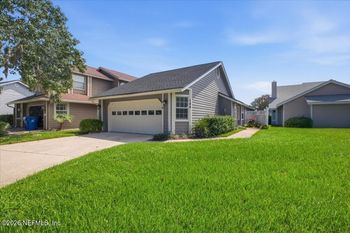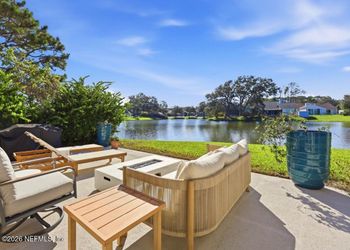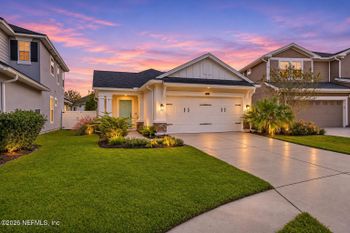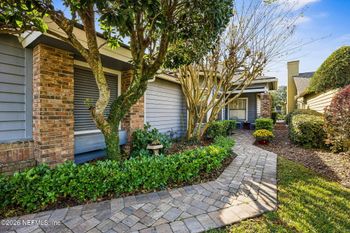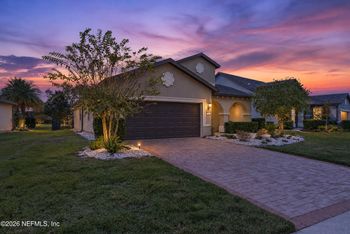

New - 22 Hours Ago
$2,700,000
Active
5
Beds
6
Baths
6500
Sqft
0.24
Acres
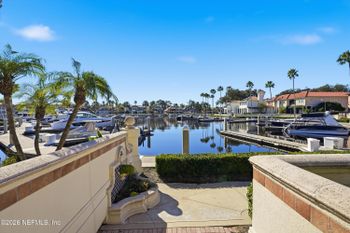
105 Bristol Pl, Ponte Vedra Beach, FL 32082
MLS#: 2173890


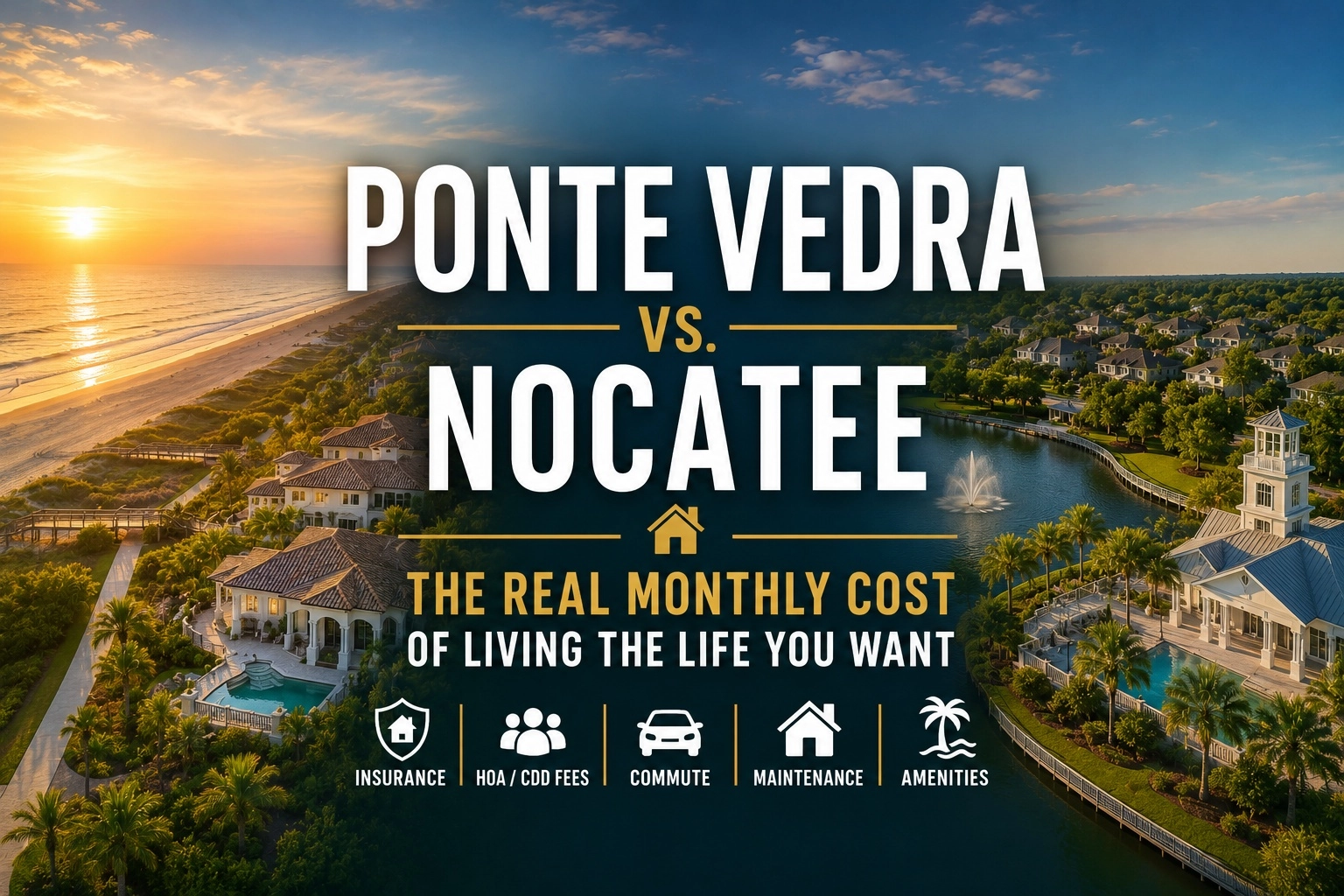
Cover illustration: Conceptual coastal and planned-community settings, rather than photographs of specific homes.
To compare Ponte Vedra Beach with Nocatee, start with two actual addresses. For each home, estimate the loan payment, property taxes after purchase, homeowners and any flood insurance, community development district (CDD) assessments, homeowners-association (HOA) or condominium dues, and maintenance you will handle. Count taxes and insurance collected through escrow only once. Then consider regular trips and the amenities available to that property. Keep ongoing bills separate from future repair allowances and optional spending.
Consider two homes: one off A1A in Ponte Vedra Beach and another in Nocatee with a Ponte Vedra mailing address. Their listings show prices and may include estimated mortgage payments. But an estimate might use the seller's property taxes, assume an insurance premium or leave out community fees; it says little about a roof or other major system that could need work after closing.
Insurance, association dues and future repairs do not divide neatly by area. A coastal house might receive a higher insurance quote; a Nocatee home might carry higher district and HOA charges. Either property could also have flood coverage, unexpected repairs or a recurring drive that changes the practical cost. The useful comparison is between the actual quotes and obligations, not an assumed trade between the two places.
Before adding those figures, make sure each address describes the location you think it does.
Ponte Vedra Beach and Nocatee are different locations, even when a listing in Nocatee says “Ponte Vedra, FL.” Ponte Vedra is also a broader mailing-address label. For this comparison, the coastal side means a particular home in or around Ponte Vedra Beach; the Nocatee side means a particular home within that inland master-planned community.
Along A1A and around Sawgrass, you will find established neighborhoods, renovated houses, golf-area properties and different types of attached and detached homes. A particular address may put you close to a public beach access or the Intracoastal Waterway. It does not automatically come with a beachfront view, a private club membership or the same wind and flood exposure as another coastal house.
One home might have a recently replaced roof and updated systems; another might need work soon. Check the parcel's mapped flood hazard, building condition and insurance eligibility rather than treating “near the beach” as a quote or an inspection report.
Nocatee is primarily in St. Johns County but also includes neighborhoods in Duval County. Its Welcome Center is at 245 Nocatee Center Way, Ponte Vedra, FL 32081. The community has paths, parks and a Town Center with groceries, dining, coffee, healthcare and services, but a home inside its boundaries is not necessarily an easy walk or short ride from every destination. Check the actual neighborhood entrance and usable path connections.
The county distinction matters for taxes and schools. On the developer's 2026–27 school information, for example, The Palms is listed among Duval neighborhoods, while the separately named The Palms Town Homes appears under St. Johns. Verify the parcel's county and the applicable district's address- and year-specific school assignment through St. Johns County or Duval County; a community name is not an assignment.
Look at the actual street, beach-access route, parcel, association rules and coastal exposure. A nearby club may be private.
This alone does not establish beachfront proximity, county, school zone, fees or whether the home is in Nocatee.
Confirm the village, county, district and association obligations, amenity eligibility and actual routes out of the neighborhood.
Use Nocatee homes for sale to compare villages and property types, then check the county, school assignment, district charges and access rules for an address you want to pursue.
Start with your financing, not the current owner's payment. The Loan Estimate distinguishes principal and interest, mortgage insurance when applicable, and estimated escrow and total monthly payment. Some property taxes, insurance and assessments may instead be paid separately. Check what your loan estimate already includes before adding anything to it.
Convert annual charges to a monthly comparison by dividing by twelve, or quarterly dues by three, but record when they are actually billed. A reserve allowance is your budget, not a bill sent every month.
Here is an easy mistake: a CDD assessment appears on the county property-tax bill, the lender collects that tax bill through escrow, and a calculator adds the CDD again as a separate “community fee.” The assessment matters, but it belongs in the total only once. Escrow can also change when taxes or insurance change, even if principal and interest stay fixed; the CFPB explains how escrow works.
Estimate the buyer's taxes, not the seller's. Florida property appraisers determine just value as of January 1. Assessed value, exemptions and taxable value are separate parts of the calculation; millage is the property-tax rate applied to taxable value. A longtime seller's homestead exemption and accumulated Save Our Homes assessment benefit generally do not carry over to the buyer. For an ordinary sale of a homesteaded property, the assessed value generally resets to just value the next January 1, subject to statutory exceptions. A purchase in 2026 can therefore affect the 2027 assessment. The purchase price helps inform an estimate; it is not an automatic tax bill.
A qualifying new homestead depends on the relevant January 1 and generally has a March 1 application deadline. After the first qualifying homestead year, Save Our Homes generally limits annual assessed-value increases to the lower of 3% or the change in the consumer price index (CPI)—not increases to the entire tax bill. Portability can let an eligible owner transfer a previous Florida homestead's Save Our Homes assessment benefit, but it has its own qualification and application requirements; it is neither inherited from the seller nor carried over from an out-of-state home. Review the Florida Department of Revenue guidance and use the actual parcel and county to estimate your taxes.
For a St. Johns County property, the property appraiser's Tax Estimator uses the most recently certified millage and allows for proposed purchase price, eligible exemptions and qualifying portability. Its estimate includes available parcel non-ad valorem items, which may include CDD charges; those amounts can change, so don't add them twice. Check the St. Johns tax bill or, for Duval property, the Duval property-tax records alongside an estimate from the correct county. A new-construction record may still value only land or unfinished improvements; ask what the completed home could mean for the future bill.
Finally, keep utilities, chosen memberships, parking and repeated travel costs visible as additional household spending. They may make one location more practical even when the mortgage-and-fee comparison looks similar, but they are not all charges collected by the lender.
For each property, check insurance alongside any special-district charges, association dues and likely maintenance. Coastal wind and flood exposure raise different questions from Nocatee's district structure, but one kind of expense does not replace another.
Ask for homeowners quotes on both addresses using comparable intended coverage. Check roof age and condition, construction, mitigation features, exclusions, and the dollar exposure from wind or hurricane deductibles. A premium depends on underwriting and the particular building, not simply its distance from A1A. Florida's consumer homeowners-insurance guidance is a useful starting point for reading what a quote does and does not cover.
Standard homeowners coverage generally excludes flood damage. Review the effective FEMA flood map for each building, while remembering that a mapped zone, an evacuation zone, past drainage and an insurer's price answer different questions. A lower mapped hazard is not zero risk. Flood coverage can come through a National Flood Insurance Program (NFIP) policy, a standalone private policy or a private homeowners-policy endorsement. A federally regulated or insured lender generally requires it for a secured building in a Special Flood Hazard Area; a lender or insurer may require it in other situations too.
If you are considering Citizens Property Insurance Corporation, a Florida property insurer, check its separate flood-coverage rules. For qualifying personal residential policies with wind coverage, Citizens requires flood insurance in Special Flood Hazard Areas and is phasing in requirements outside them. In 2026, the outside-area requirement generally applies when Coverage A is $400,000 or more; on January 1, 2027, it extends regardless of dwelling value, subject to policy exceptions. Coverage A means insured dwelling coverage, not the purchase price. Check the requirements for the proposed Citizens policy when budgeting.
A community development district is a special-purpose local government; an HOA is a private association. The Tolomato CDD publishes fiscal year 2027 (FY2027) assessments for October 1, 2026 through September 30, 2027, associated with county tax bills received in November 2026. Its St. Johns and Duval reference schedules distinguish debt service, which pays bond principal and interest, from operations and maintenance (O&M), which funds district operations such as landscaping and amenities. Paying off the debt portion does not erase ongoing O&M.
Those schedules are reference figures, not a universal Nocatee charge. Bond balances are approximate; to establish an exact district bond-debt payoff, request Tolomato CDD's estoppel letter through its designated contact. That district payoff letter is separate from any private HOA or condominium dues/status letter. Newly platted parcels or recent payoffs may not yet appear in the schedules. Match each property to its current district records, tax bill and applicable disclosures, and verify how assessments are collected.
Then check the private side: master and neighborhood association dues, condominium charges if applicable, budgets, reserves, special assessments, any transfer or capital charges, and who insures or maintains which parts of the property. The Nocatee association directory identifies neighborhoods such as Coastal Oaks and Crosswinds separately. On the coastal side, the Municipal Service District of Ponte Vedra Beach is a special taxing district, not a CDD. Check the home's current parcel taxing-district records and tax bill to determine whether the district applies and what charges are assessed. Count any charge already included in the tax estimate or escrow only once. Coastal properties can have private-association dues as well.
For a particular Nocatee neighborhood, see Coastal Oaks at Nocatee homes for sale. For a home that interests you, request its own association documents and district assessment instead of assigning a fee to the neighborhood as a whole.
A pool down the road, a beach access point or a golf course on a neighborhood map can be appealing. Before assigning those features value, ask two separate questions: can this particular owner use them, and will you use them enough to matter? A public park, district facility, neighborhood amenity and private club are not interchangeable.
Nocatee has trails, parks, Splash/Spray parks, a Swim Club, a Fitness Club and other district facilities. Under Tolomato's amenity policy amended January 27, 2026, eligibility, resident cards and visitor rules determine access. Simply occupying a residence does not establish card rights. Qualifying leases have separate rules, including an owner release of amenity rights for a non-apartment tenancy; a buyer considering rental use should read those terms.
Some facilities or programs have additional charges, and neighborhood-only amenities are separate from district amenities. Nocatee Town Center offers useful grocery, dining and service options, but check the actual path or road from the house. For example, The Link at 425 Town Plaza Avenue is a separately priced coworking and event business; the home purchase does not include a workspace membership.
Along A1A, Sawgrass and the surrounding coastal neighborhoods, the draw may be a particular beach route, golf or tennis opportunities, established landscaping, or simply the location of the house. But proximity is not entitlement. Neither a Ponte Vedra Beach address nor a Nocatee address guarantees a private beach club, dock, golf course or tennis membership.
Mickler's Landing is a public beach destination; check the drive, parking arrangements and access conditions from either house. The developer describes beach proximity from Nocatee's eastern edge, not from every home in the community. If a private club matters to you, obtain its actual eligibility, joining costs and ongoing dues separately from the home's association documents.
If neighborhood amenities are an important part of your search, Julington Creek vs. Nocatee offers another planned-community comparison.
A small difference in drive time can add up across a week, but a midday map estimate does not establish what your regular trip will take. Start with the driveway, the destination's actual entrance and the departure and return times you expect. Include grocery stops, appointments or school trips that are part of your regular week, and compare the full journey from each home.
Nocatee Parkway connects west toward U.S. 1 and east via Palm Valley Road toward A1A, across the Intracoastal Waterway. It does not have a direct I-95 interchange. The developer's I-95 directions use County Road 210 to U.S. 1 and then Nocatee Parkway. The first leg from your particular village to the parkway can matter as much as the regional route.
If the destinations are Jacksonville's Southside, downtown, Mayo Clinic, the Beaches, St. Augustine or the U.S. 1 corridor, test them separately. The Town Center may simplify some errands, but only if the store or service you need is there and the trip from your home makes sense.
A home near A1A may put a regular beach or Sawgrass stop closer, while the trip to Mayo Clinic, Southside, downtown Jacksonville or St. Augustine could look quite different. A1A, Butler Boulevard, school traffic and events near Sawgrass can change the drive. Check departure and return times from each address, including public beach access and parking if the coast is one of your stops.
For a comparison involving different road connections and school-zone questions, see Durbin vs. Nocatee.
Construction year helps you decide which systems to inspect next, but the condition of those systems determines the repair questions. Nocatee has new-home offerings; Ponte Vedra Beach includes established and renovated properties. In either place, roof and equipment condition, drainage, utility history and the owner's responsibilities matter more than a neighborhood-wide assumption about lower maintenance or energy costs.
Check the actual ages of the roof, HVAC equipment, water heater and appliances, as well as maintenance records, drainage, permits and any transferable warranties. A recent build may still need repairs or carry exterior requirements that affect future costs. Newer equipment might perform efficiently, but you need building details and utility history before estimating savings.
The developer currently advertises new single-family homes in Crosswinds. The Crosswinds at Nocatee homes for sale page includes neighborhood listings without limiting the search to new construction. Check the construction year, condition, availability and governing association of each home you compare.
Renovated kitchens and attractive landscaping can coexist with older plumbing, wiring or a roof near the end of its life. Conversely, an established house with documented replacements may have fewer immediate system needs than a newer-looking one. Check permits, roof and window details, water intrusion, drainage, tree work and salt-air effects where relevant, then get estimates for identified work rather than assigning every coastal house a large generic reserve.
An insurer may request a four-point inspection of roof, electrical, plumbing and HVAC. A wind-mitigation report documents features that may qualify for credits on the windstorm part of insurance. Neither substitutes for the buyer's own condition evaluation.
With an attached home or condominium, don't assume a label or exterior appearance means the association maintains the roof. Read the declaration and budgets to learn who pays for building coverage, exterior work, repairs and possible special assessments. Dues may cover some work without eliminating the owner's other expenses.
With the lender estimates, insurance quotes, parcel records, association documents and inspection findings together, compare the two addresses side by side. If the totals differ, identify the charges driving the gap. If they are close, repair timing and repeated trips may decide which home makes more sense.
Suppose the Nocatee home carries the higher community charge. Check how much is bond debt and how much ongoing O&M will remain even after the debt is paid off. Make sure the CDD amount on the tax bill has not been added again as a separate fee, then add any HOA or condominium dues paid directly and note known special assessments. Finally, consider how often you would use the facilities actually available to that property.
If the Ponte Vedra Beach property has lower association dues, include its insurance, maintenance and any applicable special-district charges before treating the difference as savings.
Compare the quoted coverage limits, wind or hurricane deductibles, flood coverage and exclusions. If one roof or wind-mitigation feature could make a difference, ask the insurer for revised terms rather than estimating the credit yourself. Then see how the actual premiums and possible out-of-pocket costs affect the full total alongside the HOA and CDD charges. Either home can have both insurance and community fees.
Run an ordinary week through both addresses: a work trip if relevant, food shopping, appointments, a beach visit, a swim or an evening errand. Would you use a Nocatee facility available to that home? Is A1A convenient when you would actually travel? Would a club or coworking membership add a separate bill? These details help distinguish homes whose monthly estimates are otherwise similar.
Keep the final comparison in three parts: recurring charges supported by loan, tax, insurance and association records; future-cost planning for repairs, replacements, deductibles, reserves and possible special assessments; and daily use, including repeated routes, amenity rights and optional memberships. Record the dates and any missing figures. A reserve you choose to set aside should not look like a fee already being collected.
One home may have a lower recurring payment but more repairs ahead; the other may cost more each month while making regular trips easier. Compare buyer-estimated taxes, matched homeowners and any flood quotes, applicable district and association charges, and building condition before deciding which combination works for you.
Keep the records' dates in view. A seller's 2026 tax bill may differ from a buyer's 2027 taxes, and Tolomato's FY2027 assessments apply to a defined fiscal year. If an amount is still missing, leave it marked for follow-up rather than filling in a neighborhood average.
Start with Nocatee homes for sale to identify properties for a side-by-side comparison. If you want to widen the search to another master-planned community, SilverLeaf vs. Nocatee offers a different setting to explore. The choice comes down to the two homes' bills, maintenance needs and regular routes—not a fixed cost assigned to either place.